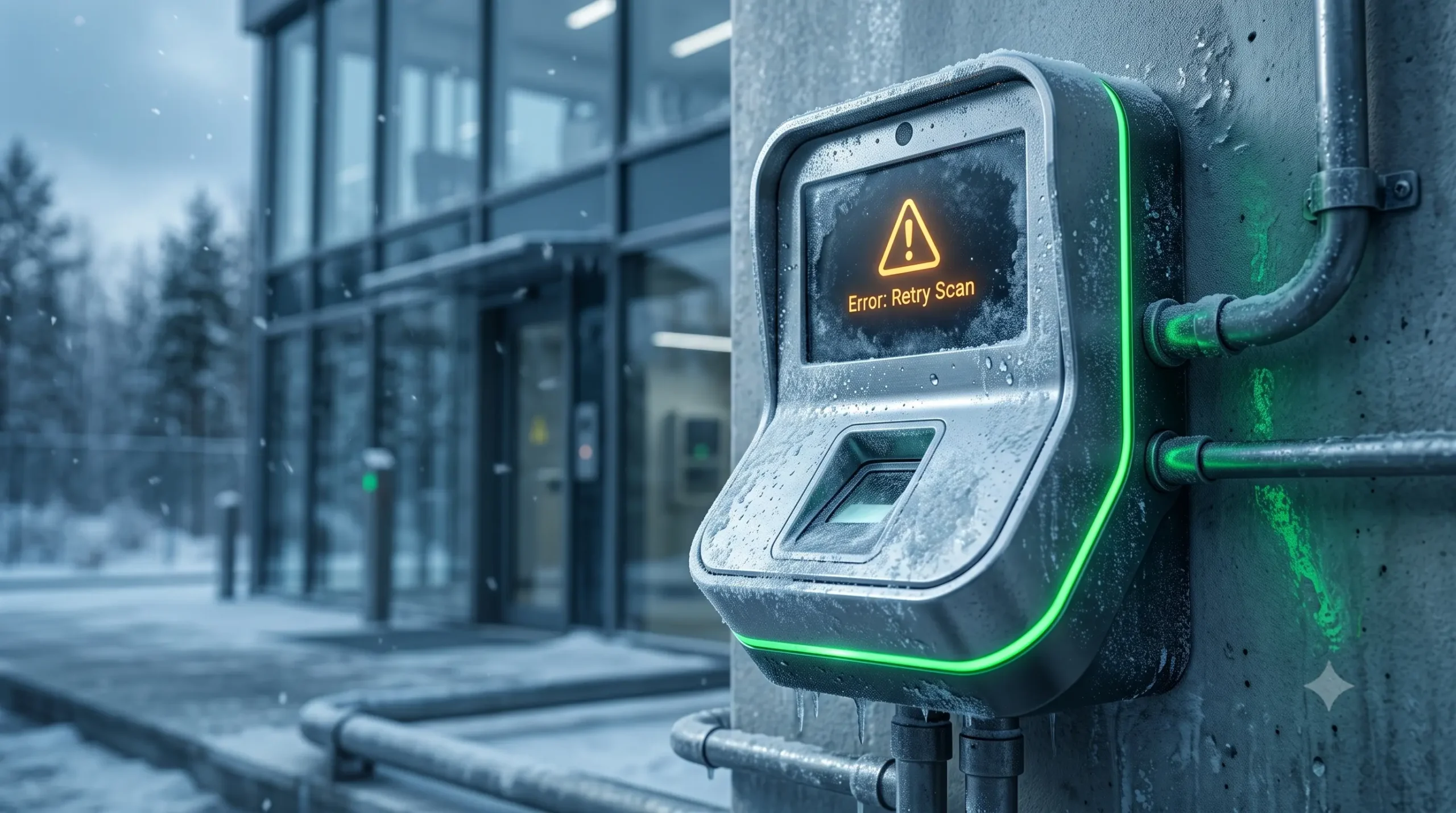

When temperatures plunge past -20°C across Canada, standard corporate security infrastructure quietly breaks down. For facilities relying on legacy fingerprint biometric authentication, winter isn’t just an inconvenience—it is a critical system vulnerability.
Traditional access control setups treat the human finger as a static, easily readable key. In real-world industrial environments, surface-level contact is a fragile point of failure.
1. The Physiology of a Frustrated Scan
Capacitive and optical fingerprint scanners rely on perfect contact with the ridges of human skin to pass an authentication token. Cold weather actively mutates these physical characteristics:
- Vasoconstriction: The body naturally restricts peripheral blood flow in the cold, causing skin tissues to shrink and flattening the micro-ridges required for a clear biometric reading.
- Moisture Volatility: The rapid transition between extreme outdoor cold and heated indoor air causes condensation or severe dryness on the skin surface, completely blinding optical sensor arrays.
2. The Cost of Mandatory Safety Overrides
When a single-modality fingerprint lock hits an exceptionally high False Rejection Rate (FRR), operations face an immediate operational bottleneck. If employees wearing industrial winter gear or cleanroom protective equipment are forced to remove gloves repeatedly in freezing conditions, entry points stall.
To maintain baseline workforce movement, security administrators are frequently forced to deploy legacy fallback options: physical keycards or manual PIN codes. The moment a facility reverts to passwords or shared cards, the core security architecture is compromised—keys can be lost, and codes can be shared.
3. Shifting the Authentication Axis
The industry-wide lesson is clear: authenticating a user based solely on exposed, surface-level physical contact introduces systemic vulnerability. True next-generation security requires looking beneath the skin.
By shifting the authentication token away from surface ridges and toward internal, zero-touch biometric markers—such as deep-tissue electrocardiography (ECG) resonance combined with advanced vocal characteristics—enterprises can achieve an un-spoofable security baseline that remains entirely immune to atmospheric extremes, ice, or protective gear.tincidunt.