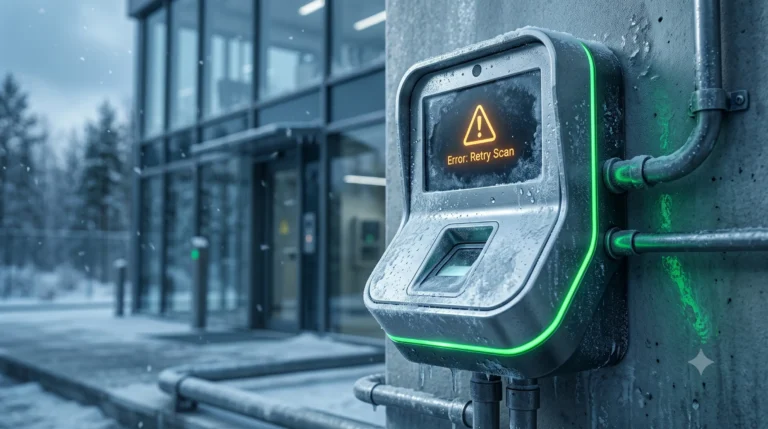

When evaluating enterprise access control, security procurement officers heavily scrutinize the False Acceptance Rate ($FAR$) to prevent unauthorized breaches. However, operations and plant managers are left to deal with the operational fallout of a completely different metric: the False Rejection Rate ($FRR$).
In high-throughput environments like cleanrooms, automotive assembly lines, and regulated manufacturing facilities, an overly rigid, single-modality biometric lock turns your security entry points into expensive operational bottlenecks.
1. The Retrying Tax: Quantifying Shift-Change Latency
A False Rejection occurs when a legitimate, authorized employee is denied access by a biometric scanner on their first attempt. While this may seem like a minor tech hiccup, when scaled across a workforce of hundreds of employees clocking in for a shift, the economic toll compounds rapidly:
- The 15-Second Decay: Every time a fingerprint reader or facial scanner fails due to wet hands, dust, safety goggles, or changing light, the employee must re-position, re-wipe the lens, or wait for a system timeout. This adds an average of 15 to 30 seconds per failure.
- Compounding Bottlenecks: During mandatory shift turnovers, a 15-second delay ripples down the entry queue. A line of 100 workers quickly experiences a costly bottleneck, leading to paid idle time and delayed floor startups.
2. Behavioral Friction: The Security Bypass Risk
When hardware inserts excessive friction into a worker’s daily routine, human behavior naturally searches for the path of least resistance.
- The Workaround Vulnerability: If a cleanroom fingerprint lock continuously rejects staff due to mandatory protective gloves, or if a facial scanner drops out due to required safety masks, personnel will actively find bypasses.
- Propping the Door Open: In real-world industrial settings, high $FRR$ directly leads to unauthorized behaviors—like employees propping secure doors open, sharing legacy bypass PIN codes, or utilizing unmonitored exits to maintain their manufacturing pace. Fragile biometrics don’t stop bad actors; they simply frustrate good workers into creating security vulnerabilities.
3. Achieving Frictionless Authority
True enterprise access control cannot sacrifice operational velocity for the sake of security. The solution lies in abandoning flat, easily interrupted surface scans.
By engineering multi-modality authentication systems that leverage internal biological markers—such as zero-touch electrocardiography (ECG) heart electrical activity matched alongside compressed-domain voice metrics—facilities eliminate surface-level interference. Because subsurface signals don’t care about dust, sweat, gloves, or ambient light, you can drastically lower your $FRR$ while simultaneously driving down your $FAR$. Protecting your infrastructure should accelerate your workflow, not freeze it.