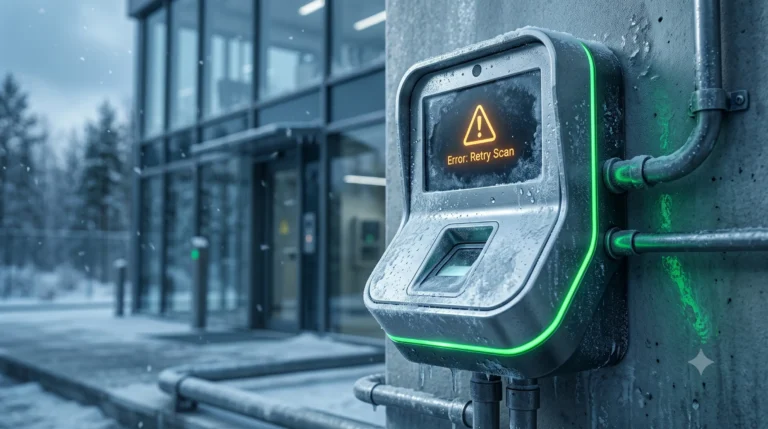

In a controlled laboratory setting, single-modality facial recognition appears flawless. However, when deployed to real-world industrial sites—such as isolated healthcare wings, sIn a controlled laboratory setting, single-modality facial recognition appears flawless. However, when deployed to real-world industrial sites—such as isolated healthcare wings, sterile cleanrooms, or high-security checkpoints—the physical reality of the workplace introduces massive system friction.
Two primary factors consistently blind traditional geometry-based camera systems: Nodal Point Occlusion and Lux Volatility.
1. The Geometry of Nodal Point Occlusion
Standard facial recognition algorithms map an identity by measuring the exact spatial distances between specific facial landmarks, known as nodal points (the distance between the eyes, the bridge of the nose, and the contour of the jaw).
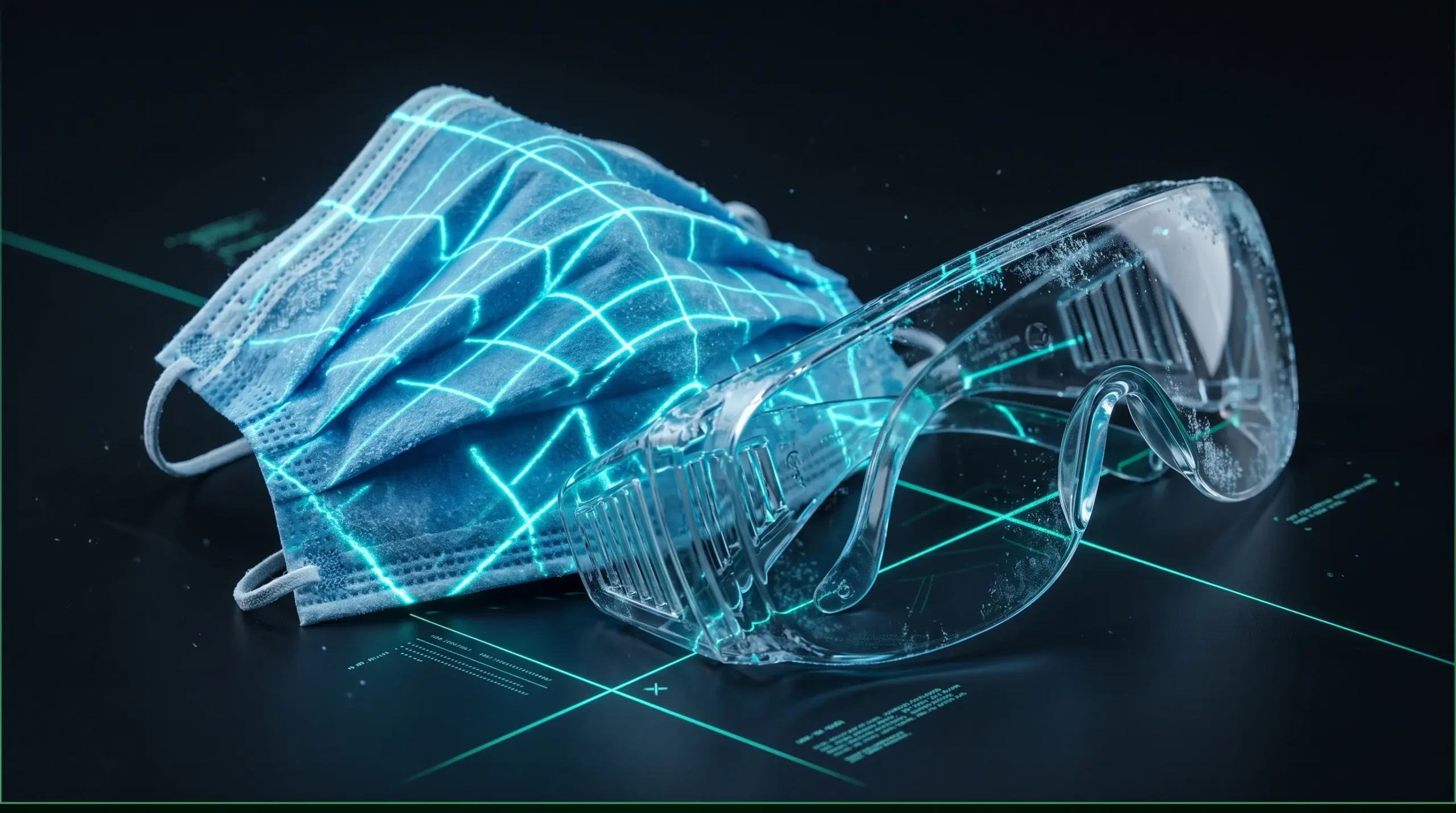
- The PPE Conflict: In secure or sterile manufacturing environments, personnel must wear mandatory personal protective equipment (PPE)—including high-filtration face masks, protective goggles, and cleanroom head coverings.
- The Mathematical Dropout: The moment a worker puts on a mask or goggles, up to 70% of these critical facial nodal points are completely obscured. The camera experiences extreme spatial distortion, causing the authentication system to drop below acceptable matching thresholds and triggering an immediate access failure.
2. The Chaos of Lux Volatility
Facial recognition sensors are fundamentally dependent on ambient light (measured in lux). Industrial sites rarely feature the consistent, uniform lighting required for high-fidelity facial mapping.
- Low-Light Faults: In dim security checkpoints, outdoor loading bays during early morning shifts, or industrial cleanrooms with specialized monochromatic lighting, sensors struggle to capture accurate shadow depth.
- The Resulting Friction: Without perfect lux conditions, the scanner cannot differentiate subtle facial contours from flat environmental shadows. To keep an enterprise secure, administrators must lower the system’s threshold, which inevitably forces a massive spike in False Rejection Rates (FRR)—rejecting legitimate workers and stalling operational throughput.
3. The Security vs. Safety Bottleneck
When forced to interact with fragile single-modality facial recognition, facilities face a dangerous bottleneck: employees are subtly encouraged to lower their masks or lift their goggles just to pass a checkpoint. This creates a direct conflict between strict security access control and mandatory workplace safety regulations.
4. Authenticating Past the Mask
To resolve this friction, enterprise security must abandon its reliance on exposed facial surface geometry.
The next generation of identity verification shifts the focus entirely inside the human body. By authenticating users through a combination of electrocardiography (ECG) heart resonance and compressed-domain voice biometrics, identity is confirmed through internal biological markers that remain completely unchanged by masks, goggles, low lighting, or protective suits. True operational resilience means your security infrastructure works with your protective equipment, not against it.