
In traditional physical security, no administrator would permit an employee to write their access password directly onto the door handle. Yet, millions of high-security facilities worldwide accept this exact vulnerability daily by utilizing static, touch-based fingerprint scanners.
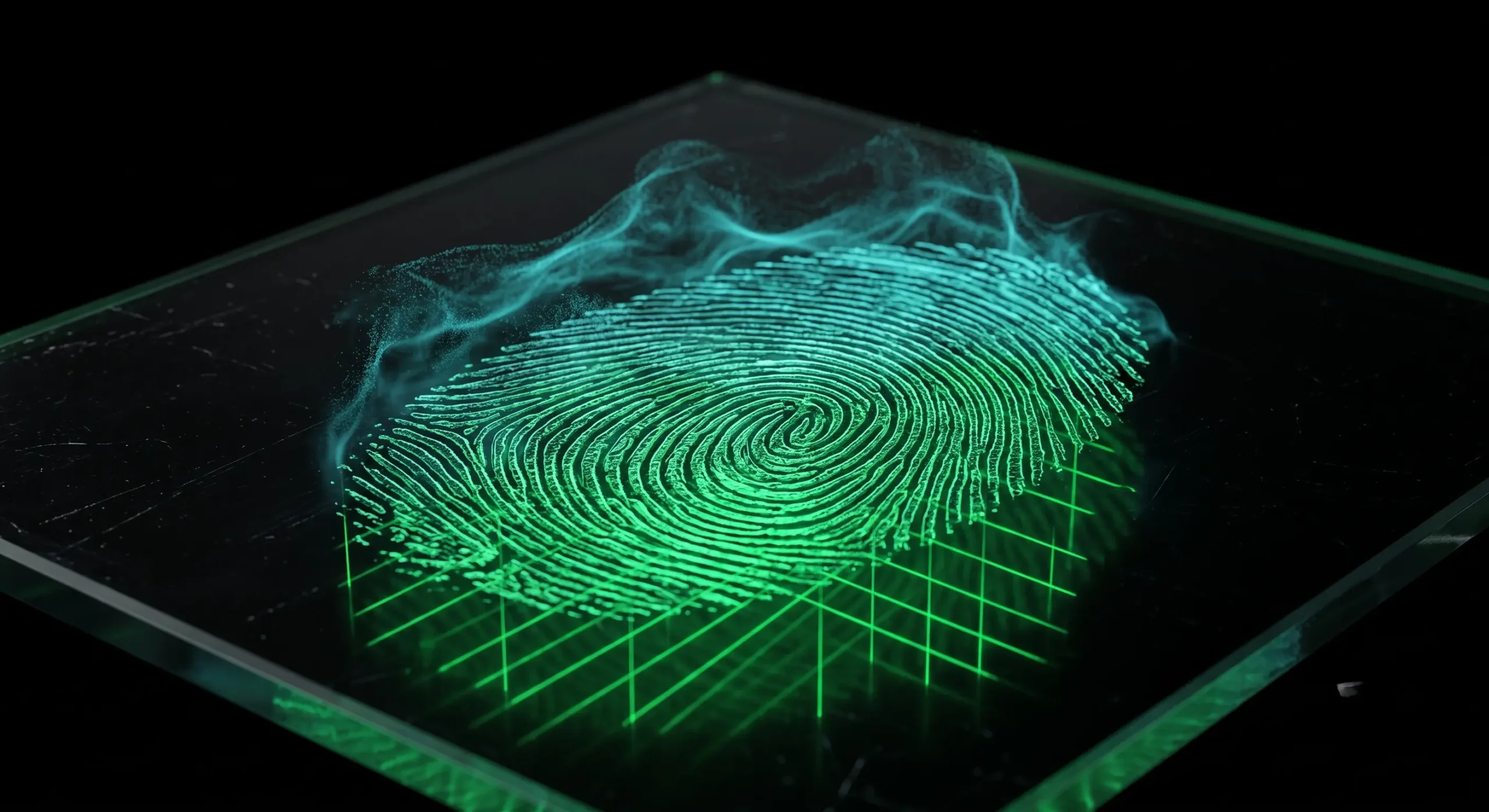
Every time an authorized user presses their finger against an optical or capacitive scanner plate, they leave behind a perfect, high-resolution replica of their biometric credential: a latent imprint. In the world of modern physical evasion, this is known as Latent Imprint Exploitation.
1. The Anatomy of a Physical Lift
When a finger contacts a scanning surface, it transfers natural sweat and sebaceous oils onto the glass or silicon substrate. These residual oils form a static, geometric map of the user’s unique print.
- The Vulnerability: These latent prints do not disappear when the user walks away. They remain perfectly preserved on the scanner plate until physically wiped down.
- The Mechanism: Bad actors can utilize inexpensive, consumer-grade materials—ranging from graphite powder and specialized adhesive tape to high-resolution mobile camera arrays—to lift these residual patterns directly off the scanner glass.
2. The Replay Attack: From Lift to Bypassing the Lock
Once a latent print is lifted, reversing the geometry to fool a standard single-modality capacitive or optical lock is surprisingly simple. Attackers can transfer the lifted pattern onto common polymers, gelatin, or thin-film silicon buttons.
When pressed against the legacy scanner, these cheap physical molds replicate the dielectric and optical properties of human skin, successfully bypassing the access node. Because traditional scanners only evaluate flat surface ridges, they lack the multi-modality filters required to distinguish a dead silicone mold from a living human presence.
3. The Irrevocable Identity Risk
This highlights the absolute highest risk of legacy biometrics: permanence without resets.
If a digital credential or smartcard is cloned, system administrators can instantly revoke the token, update the access control list, and patch the network. But if an individual’s fingerprint geometry is physically captured and copied, that biological key is compromised for life. It cannot be rotated, modified, or reissued.
4. Moving Beyond the Surface
To eliminate latent print exploitation entirely, human identity verification must move beyond exposed, static surfaces.
The future of high-security access control relies on presence-verified, multi-modality systems that fuse hidden internal biometrics—such as electrocardiography (ECG) heart electrical activity—with dynamic vocal analytics. By authenticating live, subsurface biological resonance instead of surface residue, the physical lock ceases to be a target for replication, ensuring absolute human presence without leaving a trace behind.dio varius, eget gravida suspendisse euismod ligula pellentesque. Ac quam adipiscing faucibus, risus donec eros, nullam aliquet ornare eu accumsan congue enim himenaeos.